


THE ESSENCE OF COLOMBIAN CUISINE
The bandeja paisa problem
The shorthand for Colombian food is bandeja paisa: a plate loaded with red beans, rice, ground meat, chicharrón (fried pork rinds), egg, yuca, arepa, and plantain. It exists. People actually eat it in the Andean interior. But presenting it as a national symbol is like describing the US through a Texas barbecue plate. Colombia has five ecologically distinct regions, and the food changes substantially between them. The Pacific coast cooks with coconut milk and river fish. The Llanos is cattle country with grilled meat traditions closer to Venezuelan cuisine than anything from Bogotá. The Amazon region still uses ingredients most Colombians in the capital have never seen.
The touristic image of Colombian cuisine is Andean – bandeja paisa, arepas, ajiaco, and it largely excludes Pacific and Amazonian traditions from the national picture.
What holds it together
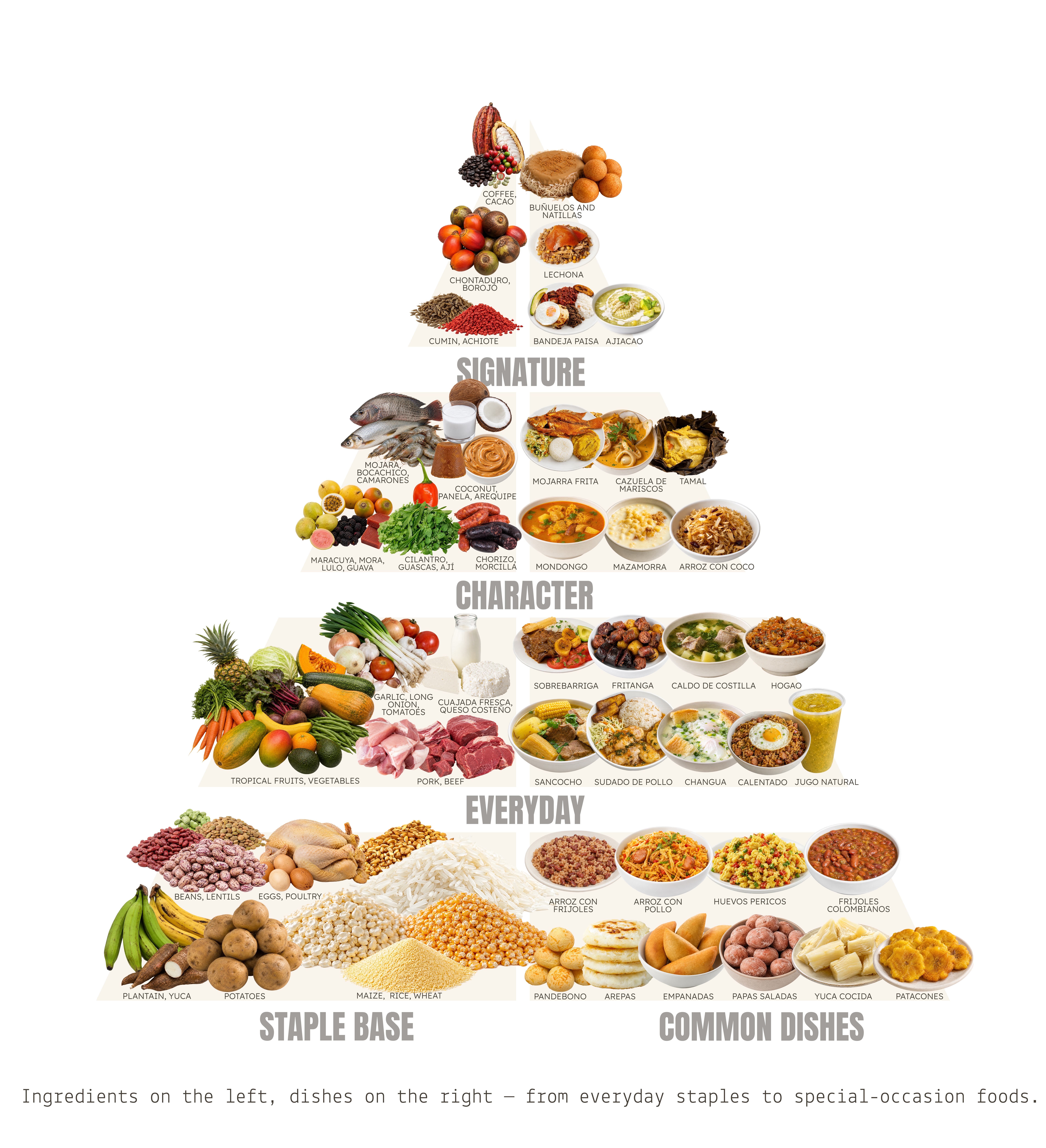
The unifier is sofrito, called hogao locally. Slow-cooked tomato and scallion, sometimes with garlic and cumin. It goes into soups, beans, rice, sauces. Alongside it, corn, potato provide the carbohydrate depending on altitude. Coastal regions swap both for plantain and yuca.
The country’s protein has historically been beans more than meat, though pork, beef, and poultry arrived with the Spanish and stayed.
The flavor profile is mild. Milder than Mexico, Peru, or any of its neighbors. But not blank. The depth comes from slow cooking and hogao, but heat is mostly optional: applied through ají sauces at the table. That mildness surprises people expecting something bolder from a South American cuisine.
At home, meals are plated. The main meal is lunch, called almuerzo, and it’s a lengthy social obligation, usually three courses: soup, a main plate, and fresh fruit juice. That juice finish is one of the more distinctive habits. Dinner is lighter, often leftovers or a small hot meal.
GRAINS IN COLOMBIAN CUISINE
Corn
Corn was here before any other grain and never lost its importance, even after five centuries of outside influence. The classic form is the arepa: a round, flat cake of precooked cornmeal, griddled or toasted. It appears at breakfast, lunch, dinner, and most points between.
The comparison people reach for is the Mexican tortilla, but the production is different. Mexican masa goes through nixtamalization—corn cooked and soaked in an alkaline lime solution, which transforms the nutritional profile and produces a specific pliable dough. Colombian arepas skip that step. They’re made from already-processed cornmeal and have a different texture entirely.
Arepas are pre-Columbian, created by Indigenous communities across what is now Colombia, Venezuela, and Panama, centuries before these borders existed. Compared to Venezuelan arepas, which are thicker, split open, eaten as a meal, the Colombian version tends to be thinner, served as a side, topped rather than filled. Stuffed varieties exist across multiple regions.
Colombia’s regions utilize corn differently. In the Andes, arepas boyacenses (thick cakes with cheese), tamales (corn dough stuffed with meat and vegetables, steamed in banana leaves), mazamorra (a thin corn porridge, usually sweet), and chicha (fermented corn drink). On the Caribbean coast: arepas de huevo, fried and stuffed with egg. In the Llanos, llanera arepas are made from ash-treated corn.
Chicha is a fermented corn drink, but the category is broader; it can be made from yuca, quinoa, or fruit, depending on the region. In its Andean form, the corn is traditionally chewed before fermentation. Saliva enzymes begin breaking down the starch. It was drunk communally, produced by women, and connected to planting and harvest cycles. Chicha was deliberately suppressed starting in the 1800s when the brewing industry, particularly Bavaria, introduced campaigns to discredit it as unhygienic in favor of beer, and that industrial campaign stuck – it never recovered its cultural drink the way it did in Peru.
Rice
Rice arrived with the Spanish and settled. But it also arrived independently through the African slave trade. Cooking rice with coconut milk on the Caribbean coast was a distinct tradition that had nothing to do with Spanish preferences. Rice didn’t compete with corn. It slotted beside the corn base.
Wheat
The Spanish brought wheat because the Eucharist required wheat bread, and corn was theologically unacceptable. It produced a thin bread tradition: mostly pan de bono and pan de yuca, both made with cassava starch and cheese rather than pure wheat flour. Colombians never built a wheat bread culture the way Mexicans did. A few reasons to it. Mexico had a head start on colonial urban infrastructure. Colombia’s colonial centers were smaller and more dispersed, so the institutional push for wheat was weaker. Mexico got a second wave from France, when the bolillo evolved from the baguette, the concha from brioche. That 19th-century French cultural influence hit Mexico hard and built out a whole bakery tradition. Meanwhile in Colombia, the arepa was so embedded across social classes that wheat never found the same urban prestige.
You cannot talk about Colombian identity without amasijos — fried or baked doughs; here, wheat comes into play. Empanadas (stuffed with meat and potatoes), buñuelos (fried cheese balls), patacones (twice-fried green plantains). They appear practically everywhere, topped with hogao or salsa rosada (mayo and ketchup). But, amasijos are made from corn, yuca, or wheat flours mixed with cheese, curd, and panela (cane sugar), often combining wheat with other local starches rather than wheat alone.
The empanada is worth noting: Colombian empanadas are made with cornmeal dough and fried, which means the most ubiquitous stuffed pastry in the country actually belongs to the corn column, not wheat. That’s the inverse of most of Latin America, where empanada dough is wheat-based.
PRODUCE IN COLOMBIAN CUISINE
Produce in Colombia is not a salad story. It builds broth, thickens stews, softens starch-heavy plates, and gives freshness beside meat, rice, beans, or arepas. Vegetable role is often additive: a protein, a starch, a cooked legume, something fried or boiled, and a small vegetable element that sharpens or moistens the plate.
This doesn’t mean vegetables are marginal. In sancocho stew, yuca, plantain, potato, corn, and squash type vegetables help make the broth filling enough to feed many people from one pot. In ajiaco, potatoes are not a side; they are the body of the soup. In beans cooked with hogao, vegetables disappear into the base and make the dish taste complete before any meat is added.
Hogao again
Hogao, also called guiso in many homes, is usually built from tomato and long green onion, sometimes with garlic, cumin, culantro, or sweet pepper depending on region and cook. Colombian hogao is soft, red, visible. It can start beans, rice, eggs, lentils, and stews, but it can also sit on top of arepas, patacones, boiled yuca, or meat. It is both base and condiment.
Beans and legumes
In Andean and Antioquian cooking especially, beans create the feeling of a proper lunch. Beans, lentils, peas, and chickpeas are served with rice, arepa, avocado, egg, pork, or plantain. A pot of beans can stretch meat, absorb hogao, and feed a household over more than one serving.
Roots and plantains
Yuca, potatoes, arracacha (Andean root vegetable), plantain, ñame (yam) often do the work that bread or pasta might do elsewhere. Some carry class meanings because they have long been associated with rural, Indigenous, Afro-Colombian, or poor households. Yuca and plantain can signal everyday survival when eaten plain, yet the same ingredients move into restaurants when fried, filled, or paired with cheese, seafood, or meat.
The gap between statistics and what gets eaten
The gap between what gets counted and what actually gets eaten is significant in the Pacific and Amazon regions. Chontaduro, a starchy orange palm fruit from along the Pacific coast, is a staple in Afro-Colombian communities and street markets. It’s sold from aluminum bowls on street corners in Cali, eaten boiled with salt and honey. Borojó, from the Chocó region, is primarily found in juices and traditional remedies. Neither appears in standard dietary statistics of Colombian food. Both are daily foods for specific communities.
Colombia’s altitude and climate produce fruits that simply don’t travel well. Some degrade quickly after harvest, which is why most people outside Colombia and Ecuador have never encountered them.
 Fresh juice the is the meal staple.
Fruit blended with water or milk. The almuerzo without juice is considered incomplete.
The fruits are exotic. Lulo (tart, green-pulped, somewhere between citrus and tomato). Maracuyá (passion fruit). Tomate de árbol (tree tomato, egg-shaped, intensely acidic). Guanábana (soursop, creamy and floral). All are almost exclusively consumed as juice rather than whole, because their acidity or texture makes fresh eating impractical. Green mango with salt, lime, or chili works as street food. Coconut is very popular on coasts, with rice, sweets, fish dishes, and sauces.
MEAT IN COLOMBIAN CUISINE
Chicken is eaten more than double the beef, but beef is more prestigious culturally. For most of Colombia’s history, cattle ranching expanded along the Caribbean coast and in Antioquia, making beef cheaper than pork. Pork costs more because Colombian corn (the feed base for pigs) was expensive and low-yielding, giving grass-fed cattle a cost advantage. Beef was ordinary food. The shift happened in 2007, when chicken overtook it in consumption volume, driven by industrial poultry farming lowering prices faster than beef producers could compete.
Colombia is mostly Catholic, which imposes only abstinence on Fridays during Lent. In coastal and riverine regions, this meant fish, turtle, and sometimes other wetland animals could fill the “not meat” category in practice. In northwestern Colombia, turtle eating became tied to Holy Week, though today trade in many turtle species is illegal.
Beef’s most Colombian expression is ternera a la llanera, or mamona. Young beef is salted, fixed onto tall stakes, and roasted upright around an open fire. The obvious comparison is Argentine asado, but asado usually centers on a parrilla (the traditional Argentine and Uruguayan term for a metal grill used to cook meats) with multiple cuts on a grill. Llanero mamona is more vertical, more exposed to the fire, and tied to cattle-plain gatherings.
Pork’s role is disproportionate to its consumption volume. The Spanish brought pigs to Colombia, and the animal became a celebration food: lechona. A whole pig, deboned, stuffed with rice, peas, pork fat, and onions, baked in an oven for up to ten hours. It originates from the Tolima Grande region and is served at weddings, festivals, and large family gatherings. Chicharrón, fried pork belly slowly rendered and then crisped, is lechona’s everyday counterpart. It appears on bandeja paisa, sold at street stalls, and eaten with arepas. The Colombian version retains a layer of meat beneath the skin.
Preservation isn’t widespread to define Colombian meat the way it does in colder or drier climates. The country is warm all year round, and the cattle economy produces fresh meat continuously. What exists is the dried beef in the Llanos, some regional chorizos and longanizas sausages.
FISH AND SEAFOOD IN COLOMBIAN CUISINE
On the Caribbean and Pacific coasts, fish is a daily protein. In the Amazon and Orinoquía river basins it’s the primary protein source for local communities. River fish has the role that beef has in Andean cities. In Bogotá and the interior highlands, fish is secondary: something eaten on Fridays, in restaurants, or when someone makes cazuela (one pot stew) for a special occasion. There’s no tradition of fermented fish, fish sauce, or dried seafood as flavor infrastructure. Fish in Colombia is a main ingredient or nothing.
The two coasts use fish differently. The Caribbean favors whole fried fish, like mojarra, coconut rice, patacones, lime, and simple sauces. It is beach food, market food, and home food. The more elaborate dish is cazuela de mariscos, a seafood stew of shrimp, fish, squid, clams, and crab cooked in coconut milk, served in still bubbling at the table. That’s celebratory food, not Tuesday lunch. The Pacific pattern is more sauce-led. Encocado seafood stew cooks fish, shrimp, crab, or piangua clams in coconut milk with hogao, herbs, annatto, and sometimes sweet pepper. Colombian ceviche exists and is popular on both coasts, but it isn’t Peruvian ceviche and shouldn’t be read as a regional variation of it. Colombian ceviche typically includes ketchup, which adds sweetness and body to the citrus base, and is commonly served with saltine crackers. Its closer in spirit to a shrimp cocktail than to the spare, acidic Peruvian. The Colombian version didn’t simplify Peruvian ceviche; it developed along different coastal influences, including Caribbean and Afro-Colombian traditions.
Inland, the key species are freshwater. Bocachico was of the most important species in the country, though overfishing and habitat deterioration have placed it under pressure. Cachama, a large river fish, is now farmed commercially and has become the main freshwater fish. For indigenous communities. fish is central to the cultural calendar, tied to seasonal cycles of rain.
EGGS AND DAIRY IN COLOMBIAN CUISINE
Dairy arrived with the Spanish in the 16th century — cattle, sheep, goats, and cheesemaking with them. What that colonial introduction determined is still visible: dairy culture is built around fresh, unaged cheeses from cow’s milk. The primary dairy is fresh white cheese, textural and salty. Queso campesino, the most produced cheese is soft, moist, mildly acidic and used in arepas, soups, and baked goods. Queso costeño from the Caribbean is firmer and saltier, grated over rice dishes or paired with suero, a fermented milk condiment that functions more like sour cream. Suero costeño is believed to have been introduced by Arab Colombians as a local adaptation of labneh — thinner, pourable, sour, drizzled over arepas and fried foods along the coast.
One Colombian preparation with dairy is really expected: chocolate santafereno. In Bogotá, hot chocolate is served with a slice of fresh cheese dropped directly into the cup, which melts and is eaten with a spoon as the chocolate flavor absorbs into it. It sounds like a dessert quirk but it’s a daily breakfast tradition. No equivalent exists elsewhere in Latin American chocolate culture.
Quite absent is a yogurt culture. Despite the dairy infrastructure, fermented drinking yogurt never became a national habit. Milk is consumed as a beverage or used in hot chocolate and desserts. Arequipe, Colombia’s version of milk caramel, belongs to the wider Latin American family of dulce de leche, but in Colombia it is strongly associated with wafers, obleas, home desserts, and bakery fillings.
DESSERTS IN COLOMBIAN CUISINE
Colombian desserts are somewhere in the middle range globally – neither too sweet nor restraint. The sweetness comes from panela, unrefined sugarcane juice: dark, more complex, with a faint molasses quality. Sugarcane arrived in Colombia with the Spanish conquest from 1538 onwards, entering a cuisine that had no prior sweetener beyond honey and fruit. It filled that gap completely. Panela became the sweetener of rural life and stayed there — aguapanela, a drink of panela dissolved in water, is a daily staple.
Colombian desserts are usually made of panela, milk, fruit, coconut, fried dough, and syrup. Compared with Peru, where pastry, meringue, and colonial convent sweets have a more publicly visible presence, Colombian sweets feel more domestic, regional, and tied to Christmas tables and street stalls. Nuts are marginal.
An important dessert is natilla paired with buñuelos at Christmas. Natilla is a thick corn custard made with panela, cinnamon, and cloves. Buñuelos without natilla, or natilla without buñuelos, reads as incomplete for Christmas.
Texture in Colombian desserts lean toward soft, creamy, and yielding. Arequipe is sometimes flattened internationally into Colombian dulce de leche. In Colombia it belongs inside obleas, beside fruits, in bakeries, and at stands where sweetness is assembled in front of you. Bocadillo, a firm guava paste cooked with panela, is the exception: dense and sliceable, eaten in squares paired with fresh cheese.
Coffee
Colombia is one of the world’s largest coffee producers, but the coffee most Colombians drink daily is not the washed single-origin lots that fetch premium prices abroad. The everyday experience is tinto – a simple, affordable black coffee served in small cups. The word comes from tinta, meaning ink, a reference to its color. Meetings begin with tinto. Negotiations pause for tinto. The cup is small precisely so it can be offered constantly without overwhelming anyone.
For most of the twentieth century, the best Colombian beans were exported, and tinto at home was made from lower grades. That equation has shifted in specialty coffee circles in Medellín and Bogotá, but the street vendor with a thermos weaving between cars at remains the image of Colombian coffee.


